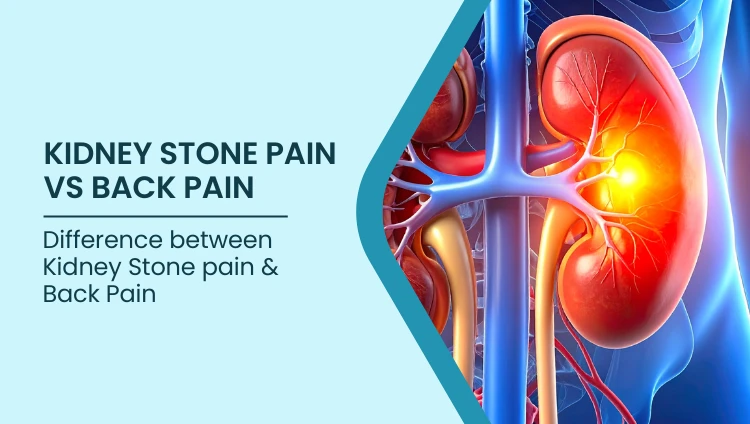
Back pain is extremely common. In Bangalore, it is often blamed on long sitting hours, posture issues, or muscle strain. While this is frequently true, kidney stone pain is often mistaken for simple back pain.
When pain is sudden, severe, shifting in nature, or associated with urinary symptoms, it may point to kidney stones rather than a muscle or spine problem. Early hospital evaluation helps identify the cause accurately and prevents complications.
No.
Kidney stone pain and back pain differ in origin, pattern, and associated symptoms.
Back pain usually arises from muscles, joints, or the spine. Kidney stone pain originates from the urinary tract, typically when a stone blocks urine flow or irritates the ureter. Doctors rely on pain behaviour and accompanying symptoms to differentiate between the two.
Kidney stone pain typically presents as:
- Sudden onset of severe pain: Pain often starts abruptly without warning.
- Pain beginning at the side or lower back: Usually felt on one side.
- Pain moving from back to abdomen or groin: Location changes as the stone moves.
- Pain coming in waves: Intensity may increase and decrease.
- Pain not relieved by rest or position change: Movement does not ease discomfort.
This pain is often intense and difficult to ignore.
Back pain related to muscles or the spine usually presents as:
- Dull or aching pain: Intensity is usually moderate.
- Pain linked to posture or movement: Sitting, bending, or lifting may worsen pain.
- Pain that improves with rest: Lying down often provides relief.
- Localised pain: Pain stays in one area and does not migrate.
- No urinary symptoms: Urination is usually unaffected.
Back pain is uncomfortable but generally predictable.
You should suspect kidney stones if back pain is associated with:
- Burning while urinating
- Blood in urine
- Frequent urge to urinate
- Nausea or vomiting
- Fever or chills
- Severe pain that comes in waves
These features are not typical of simple back pain.
Doctors recommend hospital evaluation when:
- Pain is sudden or very severe
- Pain keeps changing location
- Pain does not improve with rest or painkillers
- Urinary symptoms are present
- Fever, vomiting, or weakness occurs
- Pain keeps recurring
At this stage, investigations are required before continuing treatment.
Not every kidney stone requires admission.
Doctors decide based on:
- Size and location of the stone
- Severity of pain
- Presence of infection or fever
- Kidney function
- Ability to pass urine
Many patients are treated in OPD with medicines, pain control, and follow-up.
A hospital can arrange:
- Urine and blood tests
- Ultrasound or CT scan when required
- Pain control under medical supervision
- Specialist urology consultation
This avoids misdiagnosis and repeated visits for unresolved pain.
Yes.
Sudden severe pain requires quick evaluation. For people around BTM Layout, Jayadeva, Jayanagar, and Bannerghatta Road, choosing a nearby hospital helps with faster diagnosis, pain relief, and timely follow-ups.
At Genesiss Hospital, patients with suspected kidney stones or unexplained back pain are evaluated systematically using appropriate tests and specialist consultation. The focus is on early diagnosis and selecting the right treatment approach.
Related services include:
Back pain is common, but not all back pain is muscular. Kidney stone pain has a distinct pattern and is often associated with urinary symptoms. If pain is sudden, severe, shifting, or accompanied by urinary complaints, hospital evaluation helps identify kidney stones early and prevents complications.
How can I tell kidney stone pain from back pain?
Kidney stone pain is usually sudden, severe, wave-like, and may move from the back to the abdomen or groin. Back pain is typically dull and improves with rest.
Can kidney stone pain come and go?
Yes. Kidney stone pain often comes in waves as the stone moves through the urinary tract.
Does kidney stone pain always cause urinary symptoms?
Not always. Some people experience pain before noticing urinary symptoms.
Should I go to a hospital for severe back pain?
Yes. Severe, sudden, or unusual back pain, especially when associated with urinary symptoms, needs hospital evaluation.
Which hospital should I visit near BTM Layout for kidney stone pain?
Genesiss multi-speciality hospital in BTM Layout with diagnostic facilities and urology services is suitable for proper evaluation.